
Gem and Jewellery Export Promotion Council says step will balance trade deficit with the US.

Gold imports more than doubled in August to a record high of $10.06 billion, mainly on account of a drastic cut in customs duty and ongoing festive demand, according to the Commerce Ministry data. Gold imports stood at $4.93 billion in August 2023. On record high imports, Commerce Secretary Sunil Barthwal said that the tariff rates on gold have been reduced drastically so that smuggling and other activities can come down.

Smaller Singapore- and US-based venture capital funds, retail associations and trader bodies such as the CAIT and SJM are all planning to approach the government to put pressure on the commerce ministry.

The government's subsidised onion sale initiative, launched on September 5, has led to price drops in major cities within days, the consumer affairs ministry said on Saturday. In Delhi, retail onion price fell from Rs 60 to Rs 55 per kg, while Mumbai saw a decrease from Rs 61 to Rs 56 per kg. In Chennai, the retail price reduced from Rs 65 to Rs 58 per kg, the ministry said in a statement.

'The US is strongly placed to expand its crude supplies to India.'

We need to equip the Indian Armed Forces, not 'commercial' as Trump wants, but 'operationally' looking at growing Chinese military capabilities, asserts Lieutenant General Prakash Katoch (retd).

China was India's top import source with $65.89 billion, a 9.8 per cent year-on-year increase, worth of inbound shipments during the April-October period of this fiscal, according to the commerce ministry data. Exports to China, however, dipped by 9.37 per cent to $8 billion. During the period, the US emerged as the top export destination for the country with outbound shipments increasing by 6.31 per cent to $47.24 billion.

The Centre on Monday proposed amendments to the Consumer Protection (E-Commerce) Rules, 2020 and sought public comments on banning mis-selling and fraudulent flash sale of goods and services on e-commerce platforms, and also on making registration of these entities mandatory with DPIIT. Ban on misleading users by manipulating search results, appointment of chief compliance officer and resident grievance officer are some of the other amendments being proposed. The Consumer Protection (E-Commerce) Rules, 2020 were first notified in July last year.

What stood out in his 15-year journey as a member of the political executive at the Centre was his glowing record as India's most successful and effective finance minister. Both as prime minister and finance minister, he understood the importance of gradualism, except when the economy or the polity was in a crisis.

The wholesale price inflation rose to 1.84 per cent in September as food items, especially vegetables, turned costlier, as per the government data released on Monday. The wholesale price index (WPI)-based inflation was 1.31 per cent in August. It was (-)0.07 per cent in September last year.

Govt's e-commerce portal asks sellers to specify country origin of products. Now, the commerce & industry ministry has mandated that the Government e-Marketplace, which has seen Rs 55,048 crore worth of transactions till now, adopt this approach in the interest of creating an 'Aatmanirbhar Bharat'.

The final policy may be out only after formation of the new government, according to sources

Flipkart has long been under the ED scanner for alleged violation of FDI rules.

Wholesale price inflation rose to a 4-month high of 2.36 per cent in October as prices of food items, especially vegetables, and manufactured goods turned dearer, as per the government data released on Thursday. The wholesale price index (WPI) based inflation was 1.84 per cent in September 2024. It was (-) 0.26 per cent in October, last year.

India's merchandise exports dipped by about one per cent to $38.01 billion in December 2024 against $38.39 billion a year ago, according to government data released on Wednesday. Imports increased by 4.8 per cent to $59.95 billion in December 2024 compared to $57.15 billion in the year-ago month.

A government ministry has proposed decriminalising offences under the Collection of Statistics Act 2008 as part of the government's efforts to rationalise legislations to promote the ease of doing business. The Ministry of Statistics and Programme Implementation (MoSPI) has invited public comments on its draft proposal by October 30. The proposal to amend sections of the act will decriminalise offences like obstructing or deceiving statistics officers by doing away with the provision of simple imprisonment up to six months.

The draft favoured up to 49 per cent foreign equity in inventory model in the case of 100 per cent made in India products sold through Indian management-controlled platforms with resident Indian founders/promoters.

India and Qatar on Tuesday agreed to elevate their relationship to a strategic partnership and double bilateral trade to USD 28 billion over the next five years. Prime Minister Narendra Modi and Qatari Amir Sheikh Tamim Bin Hamad Al-Thani signed agreements and MoUs to strengthen economic cooperation, including a revised double taxation avoidance agreement. The strategic partnership will cover the "entire spectrum" of the bilateral relationship, including trade, energy security, and regional and international cooperation. Both leaders also discussed ways to further strengthen and broaden the energy partnership, including "exploring mutual investments." The Amir's visit provided an "excellent opportunity" for the top leadership of the two countries to discuss and "cement a strategic partnership for enhanced future cooperation."

The MHA on Friday, while extending the lockdown for two more weeks till May 17, lifted many restrictions in green and orange zones. There are no restrictions on sale of non-essential items by e-commerce platforms in green and orange zones, a home ministry spokesperson said, adding barber shops and salons are also allowed to open in these areas.

India's merchandise exports in October rose by 17.25 per cent to $39.2 billion against $33.43 billion a year ago, according to government data released on Thursday. Imports increased by 3.9 per cent to $66.34 billion in October compared to $63.86 billion in the year-ago period.
Government's decision comes in the backdrop of several complaints being flagged by domestic traders on heavy discounts being given by e-commerce players to consumers.

The Ministry of Mines has directed the Geological Survey of India (GSI) to conduct a re-exploration of the 5.9 million tonnes of lithium block in Jammu and Kashmir's (J&K's) Reasi district after repeated setbacks to put the reserve up for auction again in six months.
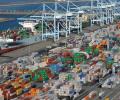
After remaining in the positive zone for three months, India's exports contracted 1.2 per cent to $33.98 billion in July, while the trade deficit widened to $23.5 billion.

Foreign direct investment (FDI) inflows into India have crossed the $1 trillion milestone in the April 2000-September 2024 period, firmly establishing the country's reputation as a safe and key investment destination globally. According to data from the Department for Promotion of Industry and Internal Trade (DPIIT), the cumulative amount of FDI, including equity, reinvested earnings and other capital, stood at $1,033.40 billion during the said period.

'We are getting to understand the mind of this generation.' 'Minor tweaks are being made to ease the process as we go along.'
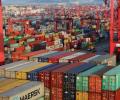
India's merchandise exports dipped marginally in March to $41.69 billion, and by 3.11 per cent during the last fiscal year to $437.06 billion mainly due to continued geopolitical turmoil, and depressed global trade. Imports, too, declined in March as well during the entire 2023-24. Trade deficit, or the gap between imports and exports, narrowed 17.74 per cent in March to $15.6 billion and came down 9.33 per cent to $240.17 billion in FY24.

'...how do they consume and contribute to the GDP?'

The cabinet of the new government led by Rekha Gupta balances representation of all major communities that propelled the Bharatiya Janata Party to power in Delhi with a massive majority after over 26 years.

He drew the roadmap of India's economic reform, unshackled it from the licence raj and pulled it back from the brink when even its gold reserve was pledged.
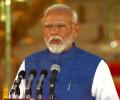
Here is the complete list of ministers in Modi 3.0 and their portfolios:

In a significant move to control spiralling onion prices ahead of the festive season, the government will transport 1,600 tonnes of buffer stock via railways from Maharashtra to Delhi - the first such initiative using rail transport for the kitchen staple. The special rake, dubbed 'Kanda Express', will depart from Maharashtra's Lasalgaon Railway Station and reach Delhi's Kishanganj Railway Station on October 20, Consumer Affairs Secretary Nidhi Khare announced on Thursday. The government expects this bulk movement to help stabilise prices in the Delhi-NCR region, where buffer stock onions are currently being sold at a subsidised rate of Rs 35 per kg.

The Centre has slapped as many as 148 notices on e-commerce players in the past three months for not complying with the mandatory display of the 'country of origin' tag on products sold. "Of the 148 notices, 56 have compounded it (the offence) and paid up around Rs 34 lakh," a senior official told Business Standard. "Every product has to display the country of origin, along with other basic information," the official added. In the case of e-commerce companies, these details have to be clearly displayed on their portals.
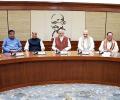
Among the new entrants to the Union cabinet, former Madhya Pradesh chief minister Shivraj Singh Chouhan has been given the agriculture and rural development portfolios, Bharatiya Janata Party president J P Nadda the health portfolio and former Haryana chief minister Manohar Lal Khattar the power portfolio.
According to CAIT, e-commerce policy should take within its ambit not only foreign players but also domestic ones.
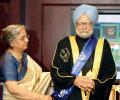
Nitin Desai, who has known Dr Singh from 1971, extends his 'deepest condolences to his wife Gurcharan Kaur and to his three talented daughters Upinder, the historian; Daman, the writer; and Amrit, the human rights activist.'

Proliferation of home chargers of around 7 KWh and above, which take six to seven hours to fully charge a car depending on the model, bring running costs down by a third or so. That, coupled with the increasing range of modern electric cars, can lead to a massive increase in sales.
India's exports registered a steepest decline in 13-month falling 9.3 per cent in August to $34.71 billion due to global economic uncertainties, while the trade deficit soared to a 10-month of $29.65 billion. According to the government data released on Tuesday, imports increased by 3.3 per cent to $64.36 billion, which is a record high, due to a significant jump in the inbound shipments of gold and silver.
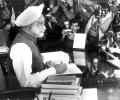
'The critical event signalling a new era for India was Dr Singh's 1991 Budget in which he quoted Victor Hugo to say that no power on earth could stop an idea whose time has come,' recalls T N Ninan.

Any government support or incentive to help exporters deal with high freight and insurance costs is unlikely.

Wholesale inflation fell to a 3-month low of 2.04 per cent in July on decline in prices of food items especially vegetables, government data released on Wednesday showed. The decline in wholesale price index (WPI) based inflation in July came after it rose for four months in a row till June, when it was 3.36 per cent. It was (-) 1.23 per cent in July last year. In April wholesale inflation stood at 1.19 per cent.
